
Solar Impulse – Around the world in a solar-powered aircraft
The dream of gliding through the air and travelling long distances without using any fossil fuels has become a reality thanks to the Solar Impulse solar-powered aeroplane.
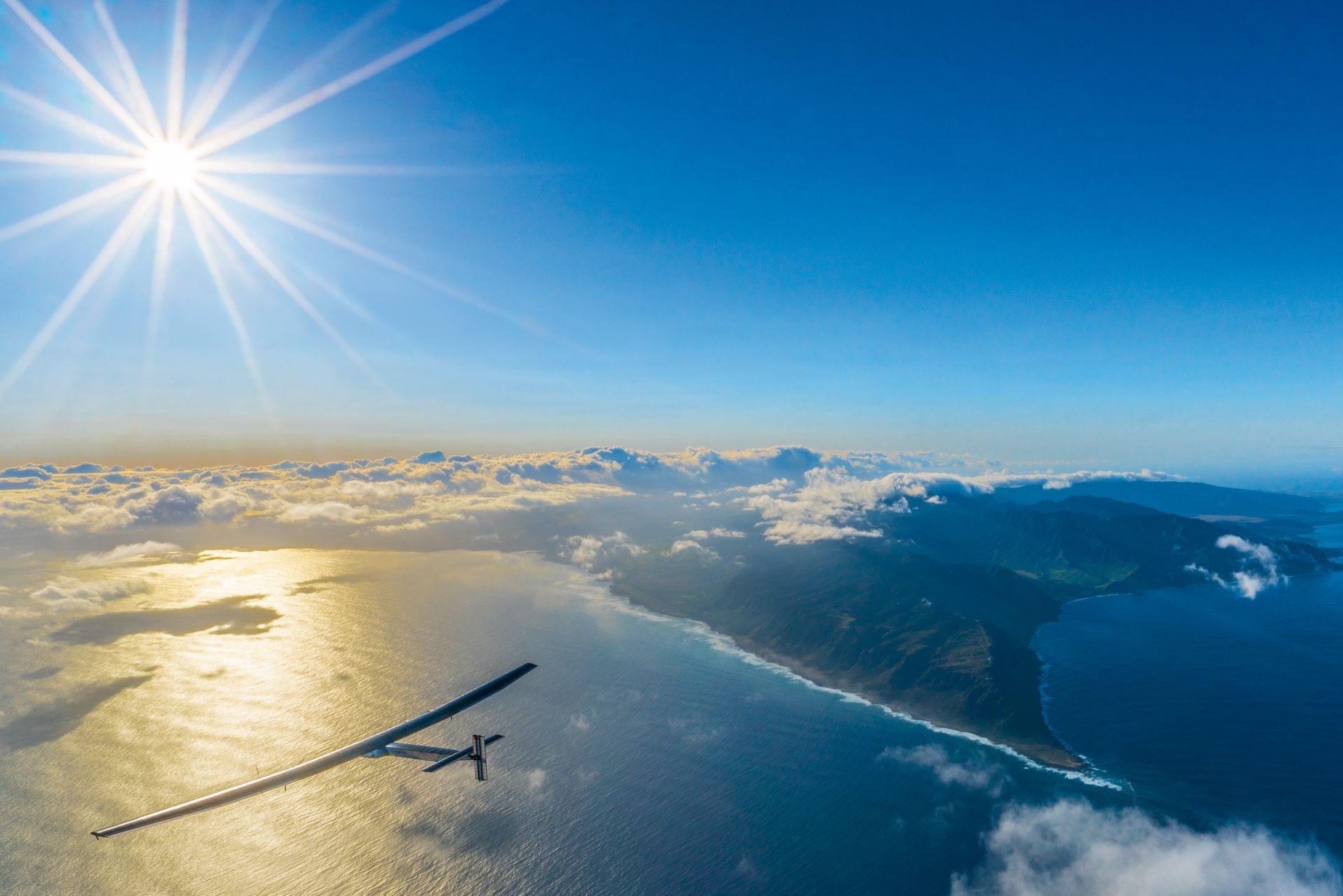
Swiss pioneers Bertrand Piccard and André Borschberg were the first to circumnavigate the globe in a solar-powered aeroplane (HB-SIB) from 9 March 2015 to 26 July 2016. Thanks to this unique adventure, they have demonstrated that with a clear objective in mind, it is possible to push the limits of what is possible. They have also promoted a more sustainable use of resources. This state of mind is perfectly in line with Switzerland's commitment to an ever ‹cleaner› use of energy sources: this is why the Confederation has supported the project from the outset.
Round-the-world solar-powered flight
From Abu Dhabi, Solar Impulse began a multi-stage round-the-world trip with stopovers in India, Myanmar and China. After a flight between Nagoya and Honolulu that will set a record for the longest duration of a solo flight on board an aeroplane – 5 days and 5 nights – the plane was forced to make a break following an operational error. The aeroplane resumed service in April 2016 by crossing the second part of the Pacific to reach the United States, crossed the Atlantic towards southern Europe/North Africa, and finally flew back to the starting point. It took 17 stages and 25 days of actual flight time spread over 17 months to cover the 43,000km of the first flight around the world without fuel. As the cockpit could only accommodate one person, the purpose of the stopovers was to change pilots, but also to present the project to the public as well as to political and scientific institutions.
Switzerland's spirit of innovation and public-private partnerships
The solar-powered aircraft Solar Impulse was designed to remain airborne day and night without using a drop of fuel. The plane’s exceptional aerodynamic performance and energy efficiency (three times greater than levels for commercial aircraft) make this possible. A team of technicians and scientists from the Swiss Federal Institute of Technology Lausanne (EPFL), led by the aeronautical engineer Borschberg and the psychiatrist Piccard from the canton of Vaud, worked together on this trailblazing project. It should come as no surprise that innovative projects like this one originate in Switzerland, when you consider the country's long-standing tradition of encouraging investment in the research and development of innovative products. Did you know, for example, that instant coffee, zip fasteners, Velcro, milk chocolate and the computer mouse were invented in Switzerland?
Switzerland's high innovation capability has also been recognised in various international rankings in this area (e.g. Global Competitiveness Report and Global Innovation Index), where Switzerland ranked at the top several times in recent years. Innovative projects thrive in the fertile environment of Switzerland's education system (see Times Higher Education Ranking) and its long tradition of cooperation between the public and private sectors. This cooperation is reflected at various levels.
A more sustainable use of resources
As a geographically small landlocked country in Europe, poor in natural resources, Switzerland has always had to use resources economically and efficiently. In addition, as Europe’s water tower, Switzerland is responsible for various sources of large rivers, and therefore manages (water) resources with great care. In this regard, the country is contending, in particular, with the progressive melting of its glaciers, which is one of the negative consequences of climate change. Switzerland is constantly aware of these negative effects and is responding by developing the sustainable use of resources and climate-friendly energy production.
Small in size, but hugely successful in terms of innovation achievements, Switzerland is continuously working with its partners to make the world a better place to live – Solar Impulse is a perfect example of Switzerland’s philosophy.