

Wild swimming: a speciality of Swiss cities
A group of people jump into the river and emerge several hundred metres downstream. River bathing is commonplace in Swiss cities and understandably fascinates visitors – where else in the world can you swim wild in the city?
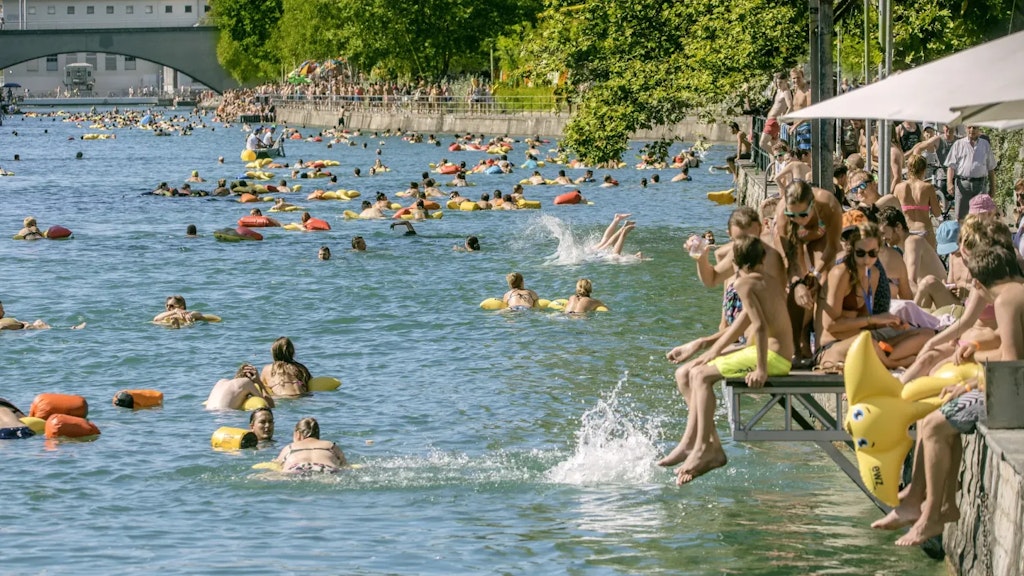
Bob down the river for a few hundred metres. Walk back upstream in your swimwear and start again, jumping from a bridge or makeshift ladder. The unusual practice of urban river bathing fascinates visitors to Swiss cities.
From Zurich to Geneva, via Bern, Basel and Thun, wild swimming has been attracting fans from all walks of life for many years. Unifying in its pure pursuit of pleasure, it is an activity that is both multicultural and typically Swiss. And for once a Swiss stereotype that is resolutely urban.
How Andreas from Germany took to city swimming
Born in Germany, Andreas Ruby became an immediate convert on his arrival in Basel in 2015. He is so enthusiastic about river bathing in the Rhine city that he has dedicated to it an exhibition – Swim City – at the Basel Museum of Architecture, which he directs. “I got into it very quickly in the company of locals. The basic rule is: always go with someone experienced, because the risks are very real. Since then, I swim every evening in summer, at around 6pm. I meet up with friends and we go in several times. It's an aquatic promenade that takes you straight to the heart of the city and gives you a new perspective on its landscape. If you let yourself be carried by the current, without really swimming, you can chat with your companions.”
It's a delightful ritual both because it's so enjoyable and because of what it says about the country that allows it to exist.
A pleasure almost unique in the world? “I don't know of any other city that offers such an opportunity except Belgrade and a few cities on the Volga. Projects are beginning to emerge, but they restrict swimming to certain areas – far from the idea of going with the flow. Except in Berlin, where you can float for 800 meters past the museums on the Spree. But it's hard to imagine going for a dip in the Seine in Paris or the Thames in London.”
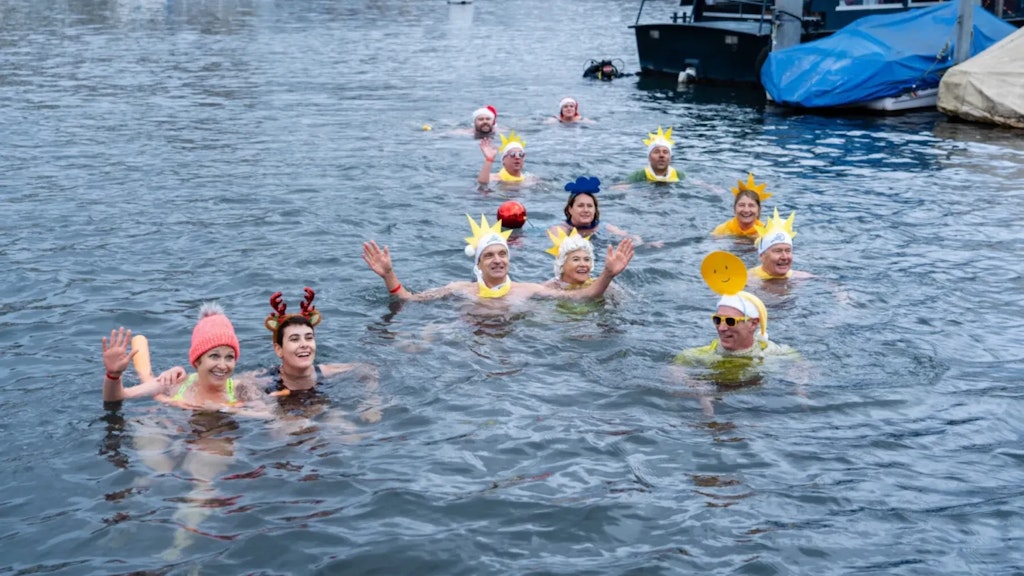
A double challenge for authorities
Wild swimming is not permitted in many rivers because of poor water quality and because it would be difficult for the authorities to ensure the safety of swimmers. Two largely unconnected factors have contributed to the rise of urban river bathing in Switzerland. In recent decades, most cantons have succeeded in improving water quality to such an extent that it has become safe for bathing, even if this was not the intention.
The issue of safety has been addressed through many years of cooperation with the Swiss Lifesaving Society (SSS), especially in the German-speaking cities. With 23,000 members in local associations, the SSS raises awareness at bathing sites, often with the help of volunteers. The SSS publishes simple and memorable rules of conduct for bathing and swimming in rivers in several languages, including English, Somali, Farsi and Portuguese. Accidents usually involve young visitors who are not aware of the risks.
The SSS plays a key role in prevention, offering various courses to improve safety around water. The ‘River’ module teaches participants how to read currents, understand the power of water and keep a constant eye on weather conditions. The course focuses on risk assessment and careful planning before and during any water-based activity. Its aim is to help people enjoy Switzerland’s rivers and streams safely, with awareness and respect for the water’s force.
On the margins of the developed city
This lack of official surveillance and the somewhat wild character of the access points give an air of freedom to these spaces in and along the rivers, which seem to have evaded the gentrified city. Geneva's more recent platforms on the Rhone, too small from the outset, and Zurich's old public baths along the Limmat, have long been overwhelmed by the hordes of city-dwellers who roam the quays in their swimwear. “What we have here is an inclusive, multicultural popular culture totally imbued with the Swiss mentality, the value of which will continue to grow,” predicts Andreas Ruby. And since everyone is in their swimsuit, the usual markers of social class disappear. “The river becomes the site of a new equality.”
Pascale – bathing in the Aare in Bern
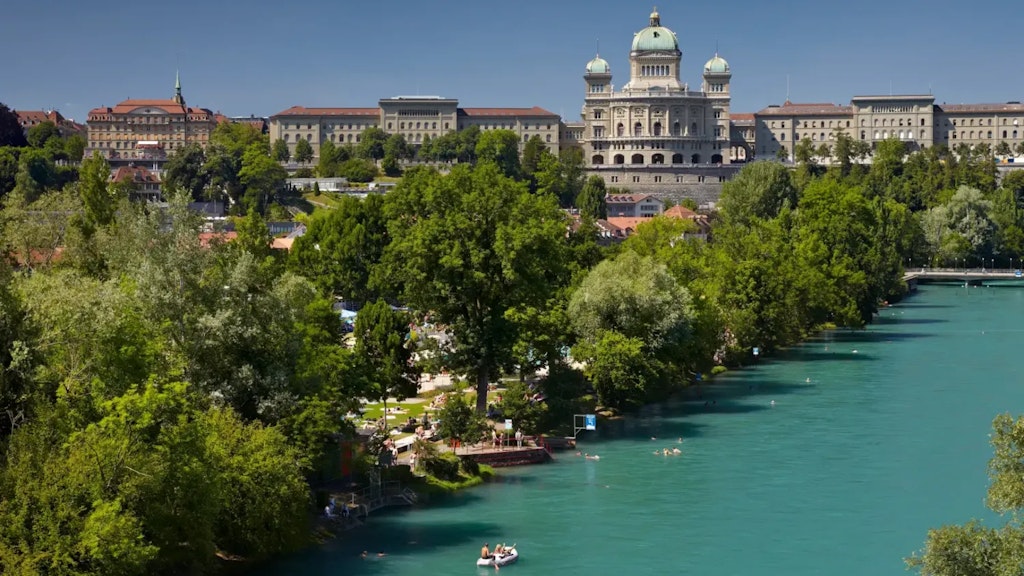
“When I decide to go to the river, I walk out of the door in my bathing suit. I drop my towel at the Marzili swimming pool, 30 metres from my building, which is close to the Aare. I always dreamed of living in a place like this, so close to the water. Like all the municipal pools, there's no entrance fee. It's public and free.
So I don't bother taking my wallet or even a padlock or a bag. In this swimmable stretch of the river – there's another in the Lorraine – Marzili is the last exit before the weir. A channel was built in 2019 to help people exit the river, but I don't use it. I start by walking up the left bank of the river for 200 or 800m, depending on my mood. I use steps or a ladder. The water is often quite cold, but once you've decided to get in, there's no point hesitating. It's also a question of habit. In summer, it's very invigorating. The rest of the year I don't swim, but I see swimmers all year round. Swimmers? Maybe that's not the right word. You don't swim in the current, you let yourself drift. Don't try to do anything else!”
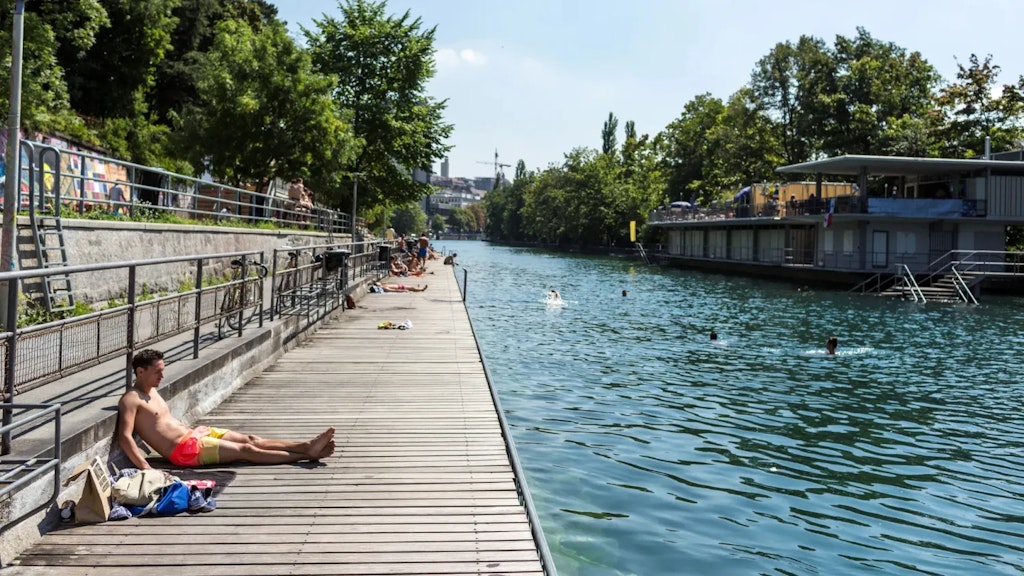
“I once took a friend who is not used to this practice, but is a good swimmer. He got scared because of the shifting and uncontrollable nature of the current. And he lost his glasses, which got caught on a tree branch. He swam too close to the edge, like many beginners who are afraid to miss the exit! It's an apprenticeship of the mind as well as the body, because you have to dare to submit to the power of the river, but still be able to free yourself at the right moment. It's nothing like swimming in a lake or pool. It's not just for crazed sportspeople either. It's a custom, almost a culture. Accidents almost always involve people who are inexperienced; tourists or passers-by who think it looks like an easy swim because so many people do it and it looks like such fun! The signs are not enough, you need a local to show you the ropes. It's about ensuring that this extraordinary urban way of life can continue. What if too many accidents call it into question? I don't even want to think about it.” (VH)
Translation of an article by Valérie Hoffmeyer originally published in Le Temps in July 2020.