
Transport
Switzerland's dense transport network gives its people a high level of personal mobility. After motor vehicles, trains are the country's most important means of transport. Rail also accounts for a substantial share of freight transport between northern and southern Europe. Switzerland has a dense and reliable transport network based on both road and rail.
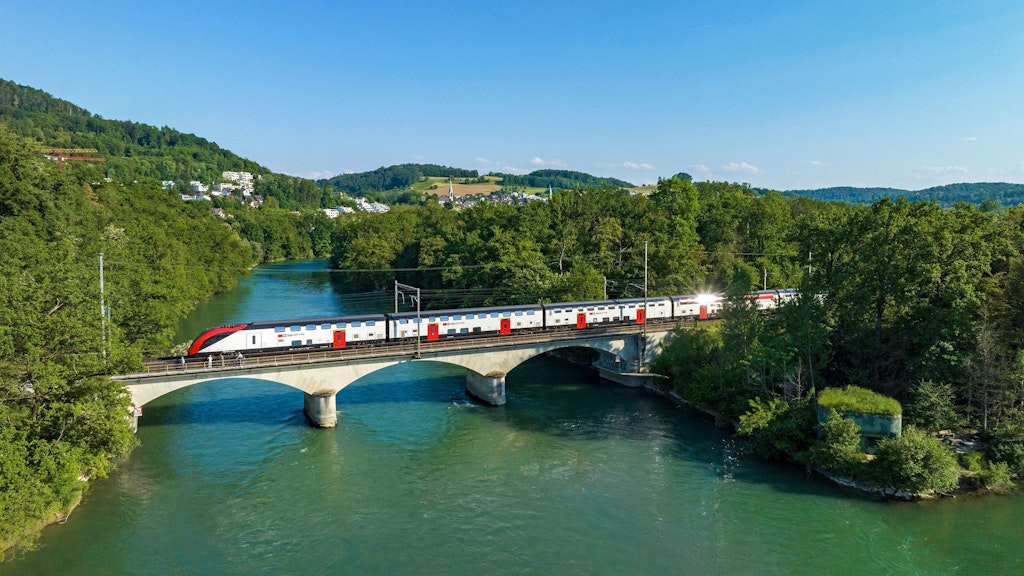
Whether by air, water, rail or road: thanks to an integrated and highly developed transport network, Switzerland's population is very mobile. The motor vehicle is the preferred means of travel. Nevertheless, the Swiss population travels by far the most kilometres by train per capita in Europe every year. Switzerland plays an important role in European passenger and goods traffic through the Alps and does so in a highly environmentally-conscious way: The Alpine Initiative (to protect the Alpine region from transit traffic) was adopted in 1994, followed by ratification of the Alpine Convention in 1999.
Public transport
The state-owned Swiss Federal Railways (SBB) is the national company for long-distance rail transport, complemented by many regional railway companies. Switzerland has a highly developed railway network, known for its punctuality and efficiency. In urban areas, a dense network of trams and buses offers a practical means of transport, while postbuses link rural and mountainous areas. Due to the many lakes, boats are also used for regular transport, as well as for tourism. In terms of air transport, Switzerland has three international airports and several regional airports. Swiss International Air Lines (SWISS) is the national airline.
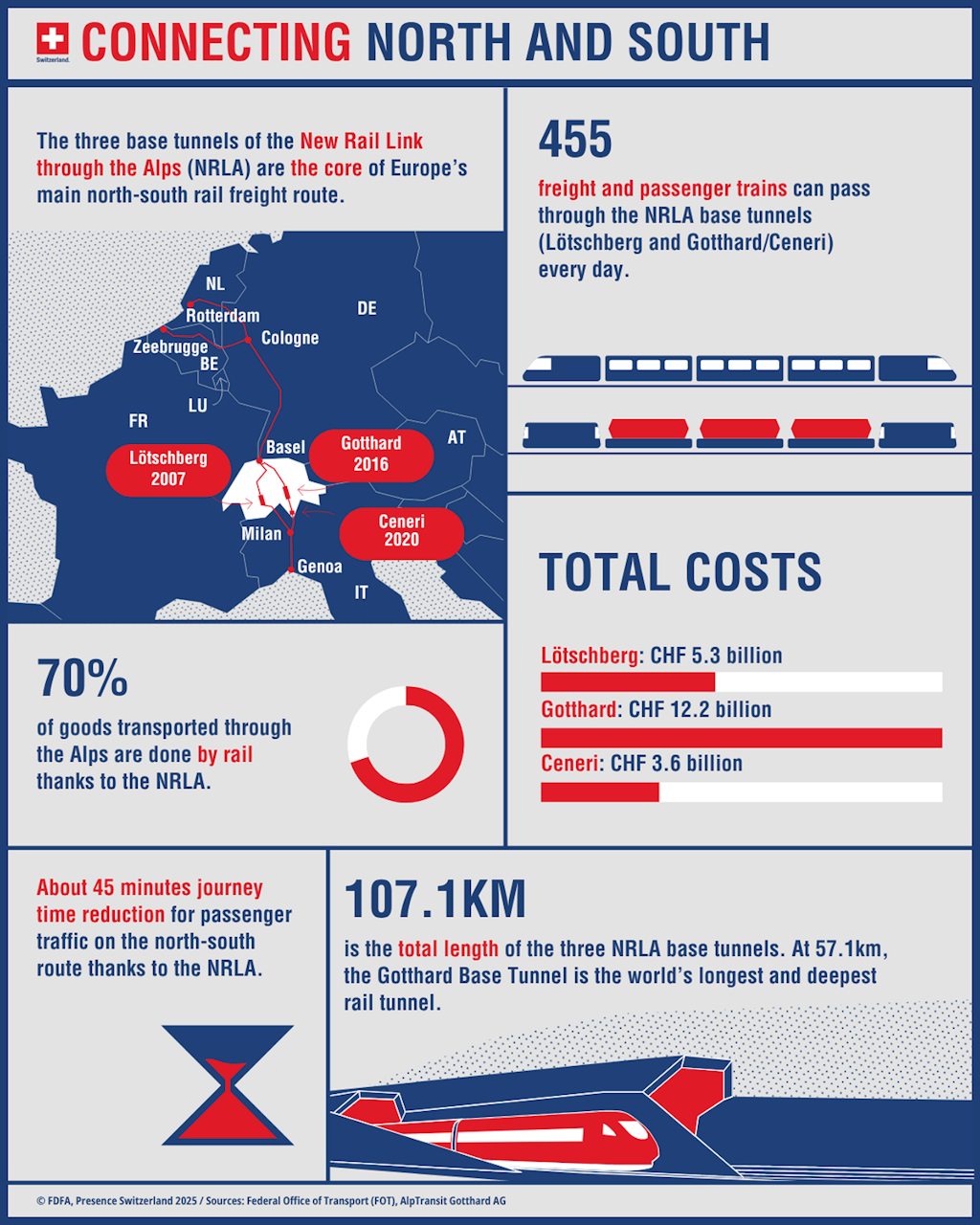
To cross the Alps on the European north–south route, Switzerland has built numerous road and rail tunnels, including the longest railway tunnel in the world, the Gotthard Base Tunnel. In order to reduce the burden on the population and the environment, Switzerland is pursuing a policy of shifting freight transport from road to rail.
The Federal Office of Transport (FOT) is responsible for public transport and ensures that it is safe, efficient, economical and environmentally friendly.
Individual transport
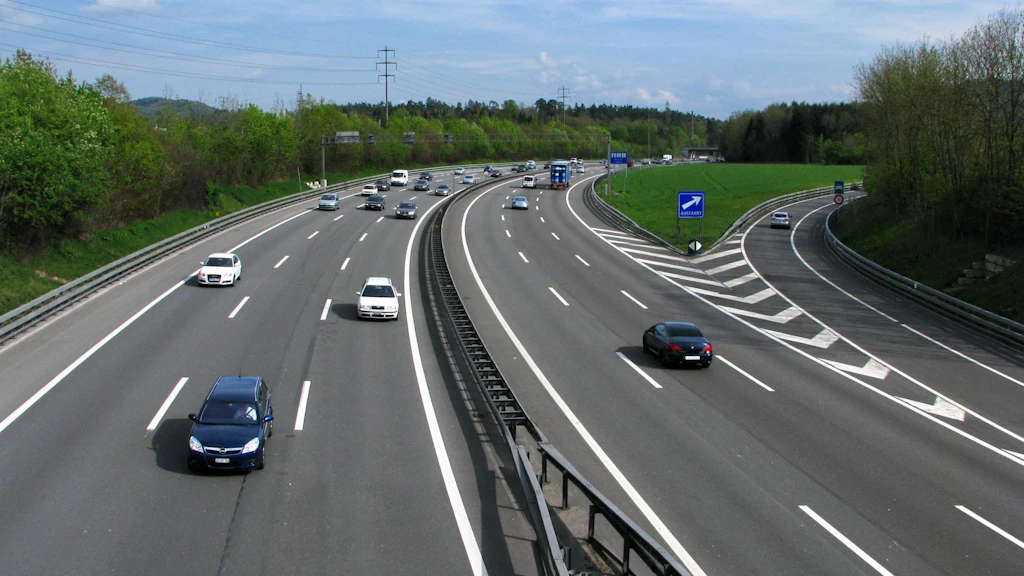
The road network in Switzerland is highly developed. The motorway network stretches across the entire country and the roads are in very good condition. Strict traffic rules ensure safety. There are many traffic calming measures in cities that restrict cars and promote public transport and cycling. Due to its mountainous terrain, but also for better transport efficiency, as well as for environmental and noise protection, there is a particularly large number of tunnels in Switzerland.
In urban centres and especially along important arteries such as the Gotthard Base Tunnel, traffic jams are a recurrent feature. This is partly due to international transit traffic, as Switzerland plays a key role as a transit country for goods travelling between northern and southern Europe.
The Federal Roads Office (FEDRO) is the Swiss authority responsible for road infrastructure and individual road traffic and keeps the population moving in a safe and sustainable way.
Future outlook
Switzerland is pursuing ambitious plans to promote sustainable mobility. This includes investing in the expansion of the public transport network, promoting carsharing and developing smart transport systems to make means of transport more efficient and environmentally friendly. Switzerland's Energy Strategy for Public Transport 2050 programme aims to reduce energy consumption in the transport sector, cut CO₂ emissions and increase the use of renewable energy on the railways, urban public transport, regional public transport on roads, shipping and cable cars, as well as on rail freight.
Facts and figures on transport in Switzerland
- Switzerland's transport network comprises around 85,000km of roads, 5,400km of railway lines, 21,200km of roads served by public transport (trams and buses), 1,000km of mountain railways and 1.4 million civil aviation take-offs and landings per year.
- Switzerland has more than 1,400 tunnels as a result of its Alpine landscape and the need for efficient transport links.
- Over 30,000 cars and coaches cross the main chain of the Alps per day in both directions. The most heavily used route is the Gotthard tunnel.
- Between 1981 and 2023, the volume of goods transported by rail and road transiting the Alps more than doubled to 37 million tonnes. Today, 70% of goods are transported through the Alps by rail, three quarters of which are combined transport.
- There are three international airports in Switzerland (Zurich, Geneva and Basel), which mainly serve destinations in Europe, the most frequent one being London. There are also 11 regional airports.
- The three largest airports, led by Zurich, handle over 50 million passengers a year and transport 360,000 tonnes of freight and mail.
- In 2024 around 6.5 million motor vehicles were registered in Switzerland, three quarters of which were cars. This means that there are 535 cars per 1,000 inhabitants, although the motorisation rate is considerably lower in urban areas.
- Basel is the home port of the Swiss deep-sea fleet: this comprises 11 merchant ships from two shipping companies.
- 150 passenger ships and 120 freight ships with a federal licence operate on Swiss lakes and rivers as well as border waters.
- With over 2,000 trains passing per day and 80 per hour, the section between Zurich main station and Langstrasse is one of the busiest railway lines in Switzerland – and Europe.
Swiss transport records
- The Swiss railway network is the most intensively used in Europe: On average, 137 passenger trains travel each line each day – around one every nine minutes. Switzerland is also a leader in freight transport.
- The most important public transport structure is the 57km-long Gotthard Base Tunnel. In the world's longest railway tunnel, 325 trains travel at speeds of up to 250km/h every day.
- For years, the Swiss have held the European record for domestic rail travel, both in terms of number of journeys and kilometres travelled: at an average of 2,500 kilometres per year, they travel around 1,000 kilometres more than the next highest ranked countries Austria and France.
- From Ouchy (on Lake Geneva) to Croisettes (on a hill), the automated M2 line of the Lausanne Métro can cope with an altitude gain of 338m with gradients of up to 12% – without gears or cable support. That is a world record for rubber-tyred underground trains.
- The Baselland Transport BLT tram line no. 10 from Dornach to Rodersdorf is the longest in Europe. Covering 25km, it runs through three cantons (Basel-Landschaft, Basel-Stadt and Solothurn) and two countries (Switzerland and France).
Discover more
Passenger transport
The reliability of the Swiss railway is almost proverbial, but the car is still the most popular mode of transport for the Swiss population.

Freight transport
60% of freight in Switzerland is carried by road and 40% by rail for long distances.