
Compulsory education
Compulsory schooling (11 years) comprises the primary and lower-secondary levels. Children start primary school from the age of four, where they acquire and develop the basic knowledge for the next years of their education. Compulsory education is completed after the lower-secondary level, which usually lasts three years. Almost all children in Switzerland attend government-run schools to obtain their compulsory education.
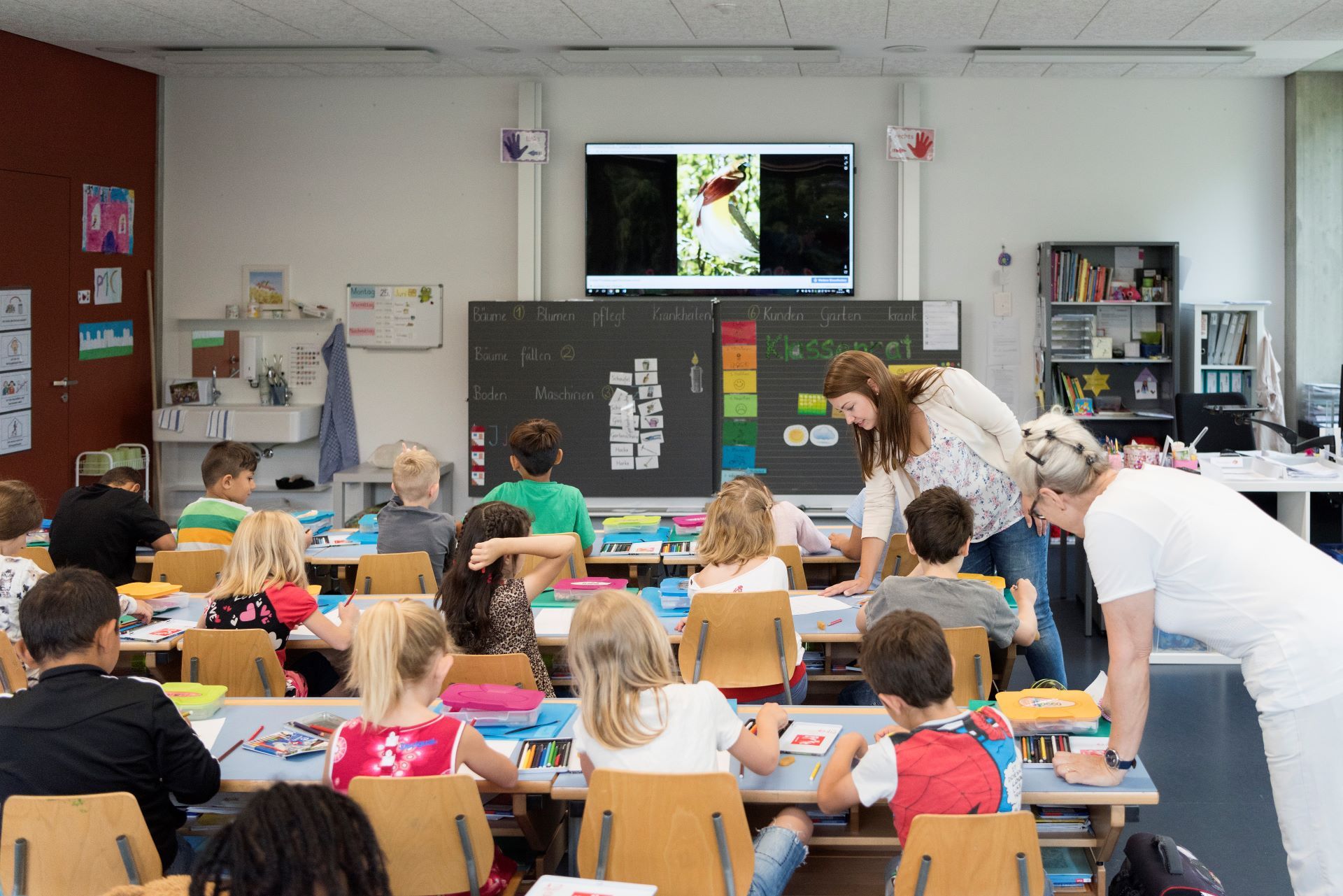
Compulsory education is the responsibility of the cantons. Their tasks include drawing up the curriculum and determining which material will be used, while the communes organise schooling logistics and the federal government assures quality. Differences between the cantons are ironed out by a school concordat for the harmonisation of compulsory education (HarmoS) which came into force in 2009. Despite this, substantial differences between the various cantons' education systems persist.
Compulsory schooling comprises the primary and lower-secondary levels.
Primary level
Primary school begins with kindergarten, which usually lasts two years and is attended from age four. In some cantons there is a first learning cycle instead of kindergarten, where four-year-old to eight-year-old children attend the same class. In the following years of primary school, the children learn the three Rs and also acquire a basic knowledge of two foreign languages (usually a second national language and English), geography, history, drawing and music. Current topics such as the use of new media, health, sustainable development and civics are integrated into the other subjects.
Lower-secondary level
The lower-secondary level follows immediately after the primary level. Pupils switch to this level around the age of 12, following an assessment to determine their ability to perform at lower-secondary level. In the lower-secondary level, which usually lasts three years, the focus is on young people's progression and personal development. They learn to take personal responsibility, show initiative, identify and solve problems, deal with conflicts, and work both independently and in groups. These years also prepare them for the upper-secondary level.
After their compulsory education is completed, young people move on to upper-secondary education, where they can choose between two educational paths: basic vocational education and training or the general academic route.